ABO Academy
ABO Academy (IBO Academy in North America) is Amway’s global learning platform used across 100+ markets by millions of business owners. As the primary UX/UI designer, I led the admin web experience and the learner-facing mobile app. My work improved course discovery, strengthened mobile usability, and established a scalable multi‑language design system—contributing to a 400% increase in monthly active users and a 112% rise in course completions worldwide
ROLE UX/UI Designer | TIME 2022-2025
TEAM Engineers and Project Manager
TOOLS Figma, FigJam, Adobe Illustrator, and User Zoom.
DELIVERABLES: Research presentation, Interactive Prototype made with Figma, User testing of Prototype, User Flows
Problem Statement
Because training was scattered across multiple channels, ABOs lacked clear learning paths that slowed their onboarding and business growth.
Issues
There was no centralized learning hub, leaving ABOs to piece together information from scattered PDFs, informal coaching, meeting notes, random videos, and social media. This fragmentation led to inconsistent knowledge, outdated guidance, and confusion about what to prioritize. Even motivated ABOs struggled to learn because finding reliable, structured content required time they didn’t have — ultimately impacting confidence, clarity, and business growth.
Goals
Creating opportunities for ABOs to learn faster, sell better, lead confidently, stay compliant, and build a sustainable business — all through a centralized, mobile‑first learning experience integrated into their daily workflow. By delivering training in bite-sized, easy‑to‑digest lessons, the app helps ABOs build skills quickly, apply what they learn in real time, and ultimately grow their business with greater confidence and consistency.
Personas
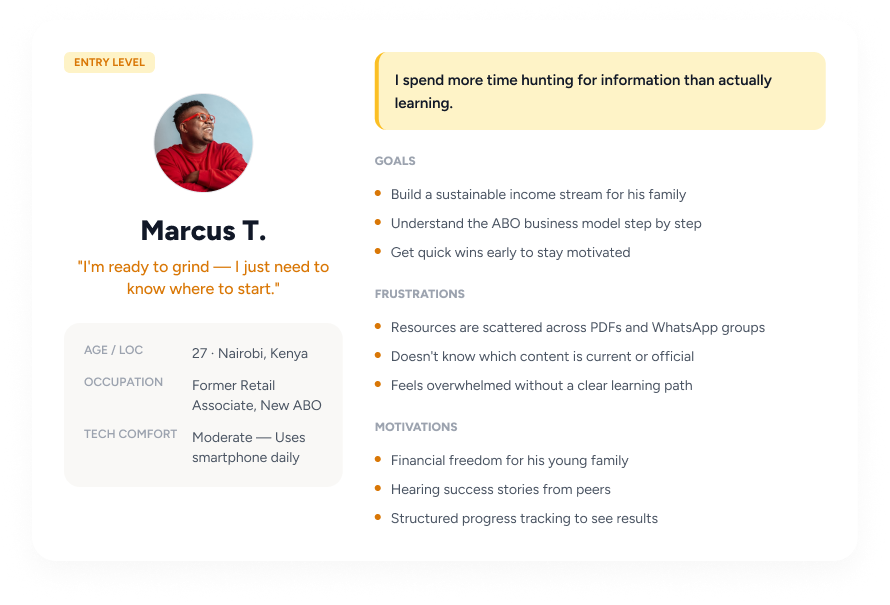
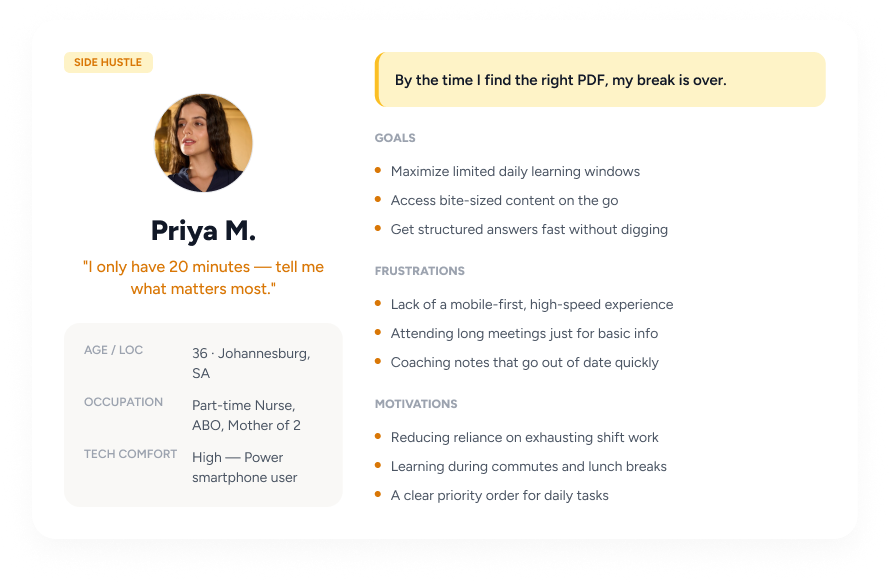
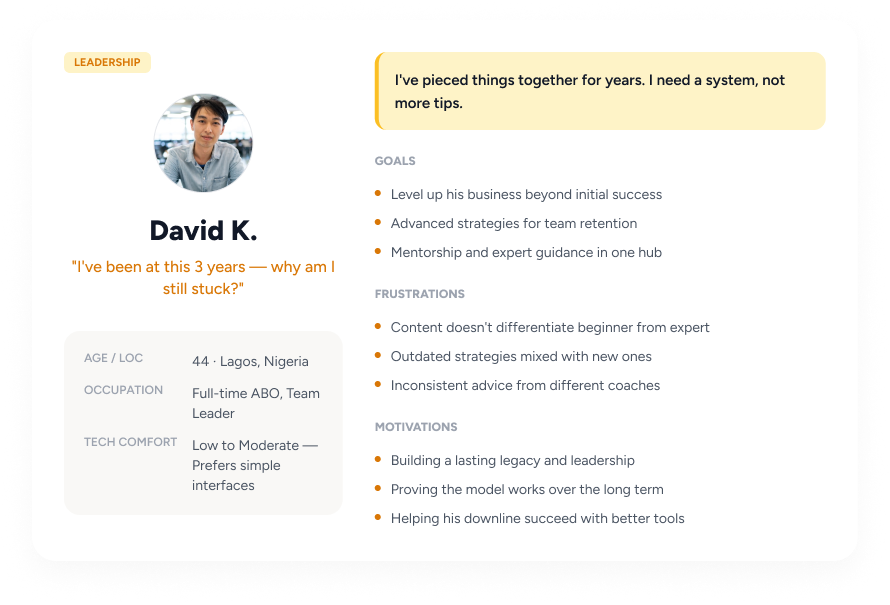
Research and Insight
-
Throughout the development of the Academy experience, I played a key role in conducting iterative usability reviews to ensure the product was intuitive, accessible, and aligned with the needs of Amway Business Owners (ABOs/IBOs). Our testing approach combined A/B experiments, moderated usability sessions, and continuous feedback loops with global markets, admins, and business owners.
We focused on evaluating and refining key areas of the experience, including:
A/B testing of navigation patterns and content layouts to understand which structures reduced friction.
Lesson structure and readability to support micro‑learning and improve comprehension.
Mobile accessibility and interaction behavior to ensure the experience worked seamlessly for on‑the‑go learning.
Integration with Amway+ for a consistent cross‑platform experience.
Content discoverability — how quickly ABOs could find relevant courses and product information.
These usability reviews ensured the Academy experience was intuitive and accessible across markets and skill levels.
-
To validate the Academy experience, we tested core areas of the product to ensure usability, clarity, and accessibility across global markets. Our usability reviews focused on:
Navigation clarity and course discoverability
A/B testing of navigation patterns and content layouts
Lesson structure, readability, and micro‑learning pacing
Mobile accessibility and interaction behavior
Integration with Amway+ for seamless cross‑platform use
Visibility and understanding of gamification elements
How quickly ABOs could locate relevant product content
These tests helped us identify friction points early and refine the experience to support users across different markets and skill levels.
-
Usability testing revealed several key insights about how ABOs interact with the Academy experience:
Simplified navigation reduced friction — users found courses faster and with fewer misclicks.
Shorter micro‑learning lessons reduced drop-off — bite‑sized content felt more approachable and easier to complete.
Mobile-first layouts aligned with real IBO workflows — most users learn on-the-go, and mobile optimization significantly increased completion rates.
Gamification elements boosted motivation — points, badges, and streaks encouraged repeat visits and sustained engagement.
Some markets needed clearer iconography — users with varying digital literacy relied heavily on visual cues and labels.
Users wanted faster access to product reference content — especially during real-world selling where quick information builds confidence.
These insights helped us identify friction points early and directly informed the design decisions that shaped the final Academy experience.
-
Based on the insights from usability testing, we refined key areas of the Academy experience to improve clarity, accessibility, and overall engagement:
Refined navigation labels and improved visual hierarchy to make course discovery more intuitive.
Adjusted lesson pacing and content chunking to better support micro‑learning and reduce cognitive load.
Enhanced mobile interactions by improving tap targets, spacing, and scroll behavior for on‑the‑go learning.
Added onboarding tooltips to help users understand gamification elements and progress indicators.
Simplified iconography and added text labels to support markets with varying levels of digital literacy.
Created quick product reference cards to give ABOs fast access to product information during real‑world selling.
These refinements directly addressed user pain points and shaped a more intuitive, accessible, and motivating learning experience across global markets.
-
Improved usability across core learning flows
Increased clarity in navigation and lesson structure
Higher engagement driven by gamification
Better completion rates through micro‑learning
A more intuitive experience across global markets
These iterative usability cycles ensured the Academy experience was intuitive, accessible, and motivating across markets and skill levels. Each round of testing directly shaped the final design, helping us deliver a learning platform that better supports IBOs in building product knowledge and confidence.
Challenges and Design Eploration
Challenges
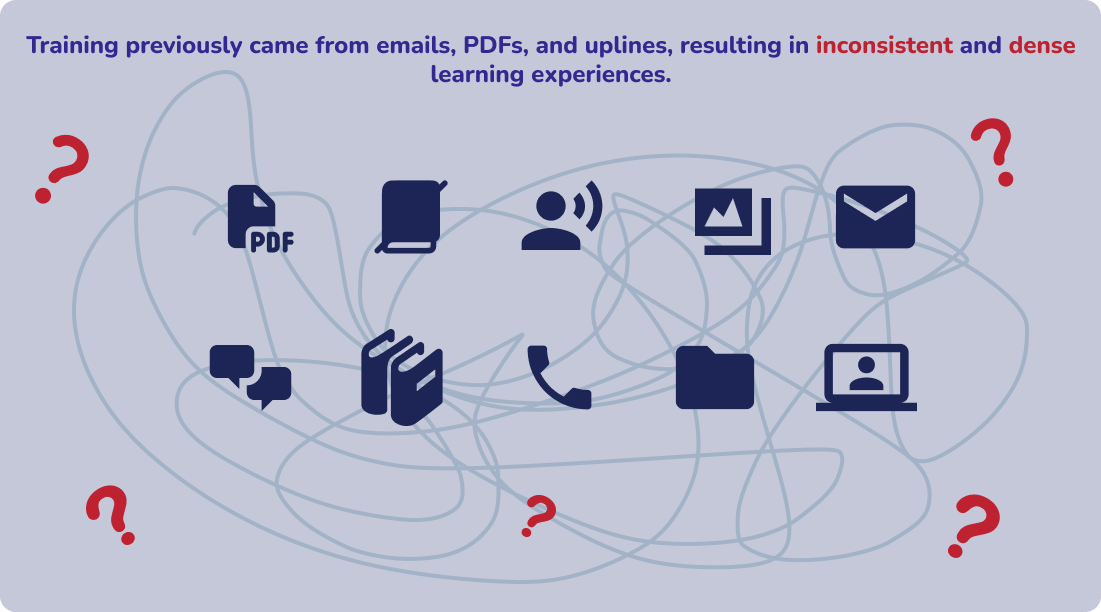
Fragmented Learning Experiences
Challenges: Training was scattered across PDFs, videos, chats, and informal coaching, making it hard for ABOs to find reliable information.
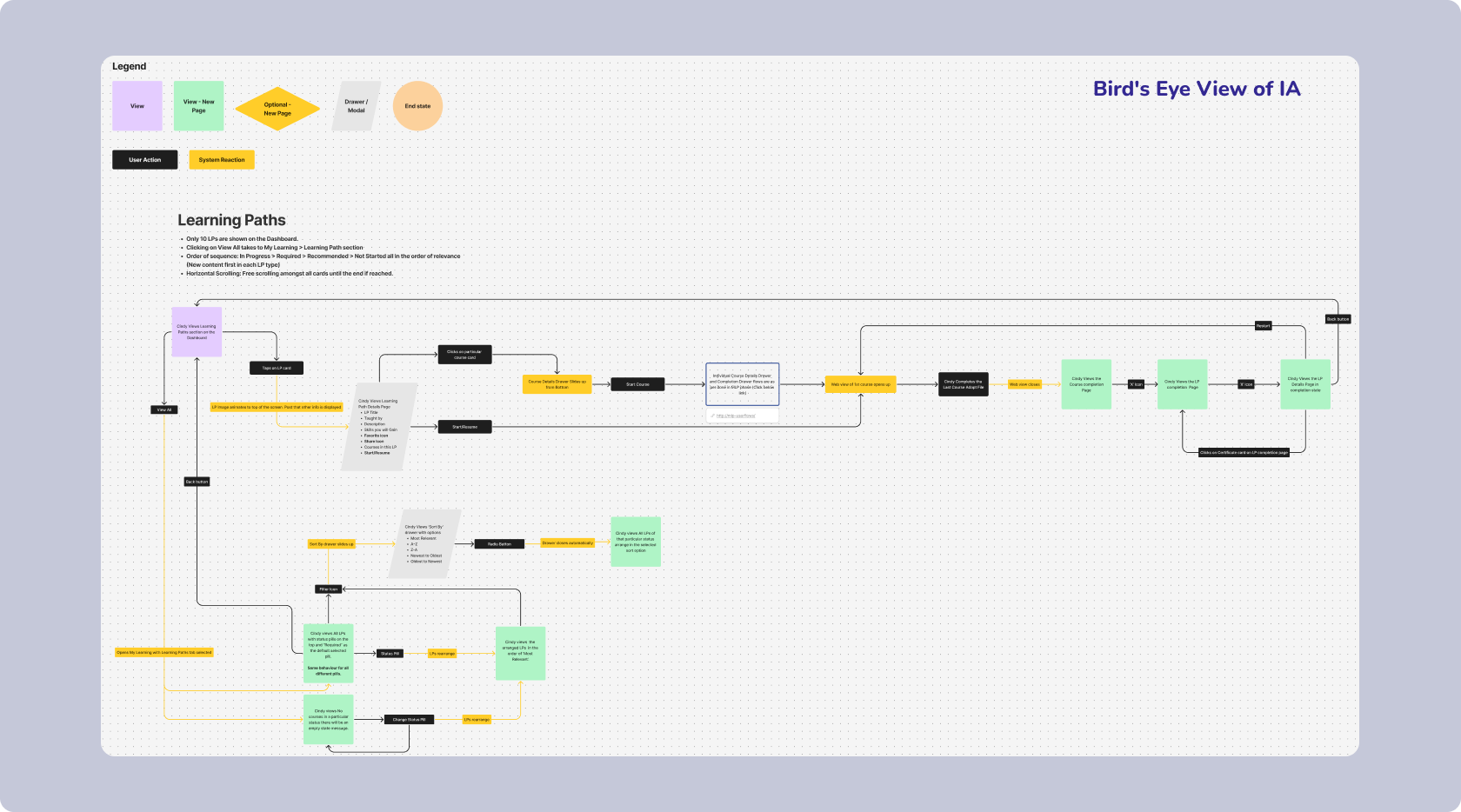
Design Exploration:We explored ways to centralize content, tested different IA structures, and validated a unified learning hub through user testing.
No Clear Starting Point
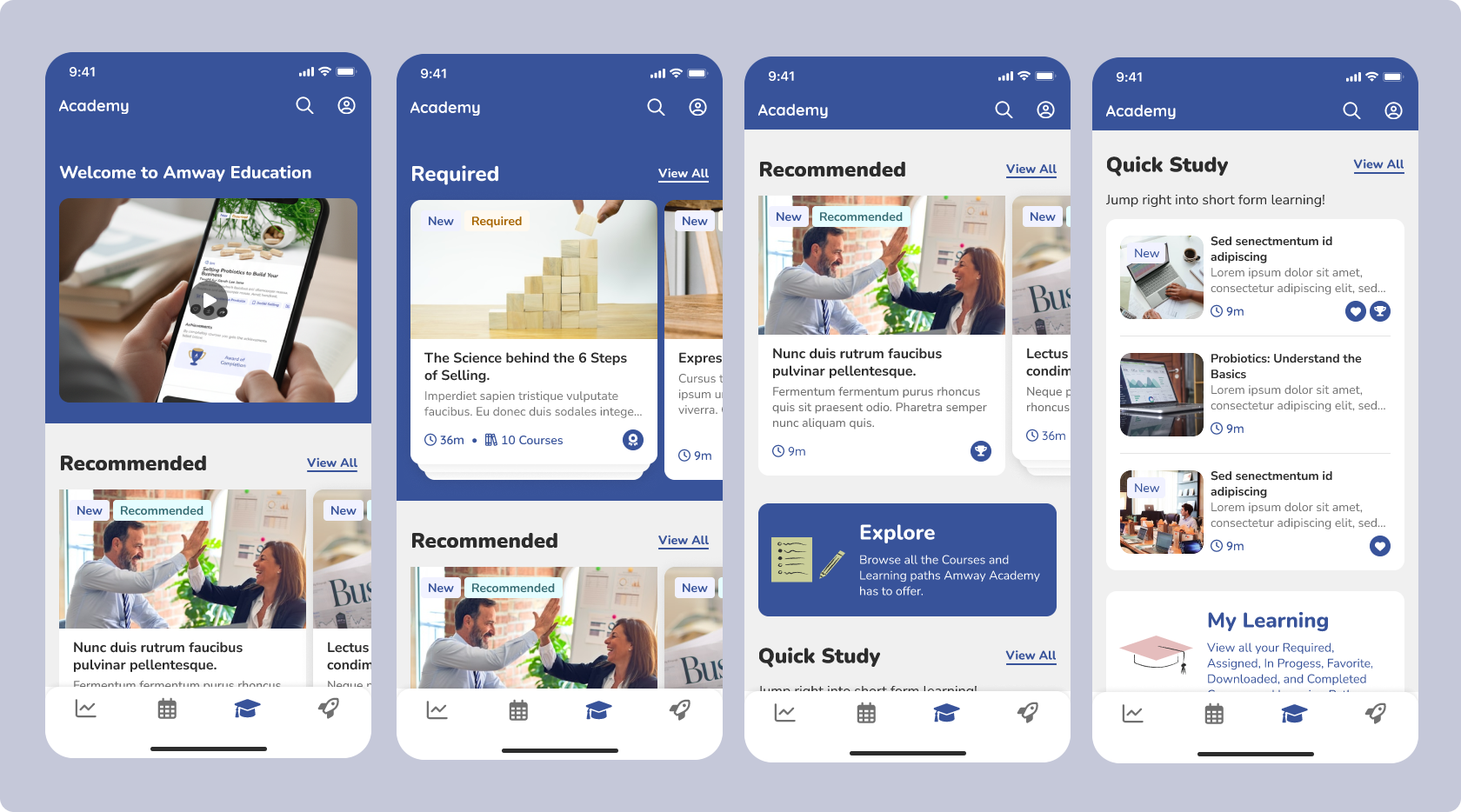
Challenges: New ABOs didn’t know what to learn first or how to progress, which created overwhelm and slowed onboarding.
Design Exploration: We added a welcome video, guided tour to orient new ABOs, options for several guided learning paths, and step‑by‑step onboarding flows. User testing helped us refine the sequence, so essential lessons appear first, while still allowing ABOs to search, explore, and follow optional paths at their own pace.
Content Too Dense and Not Mobile‑Friendly
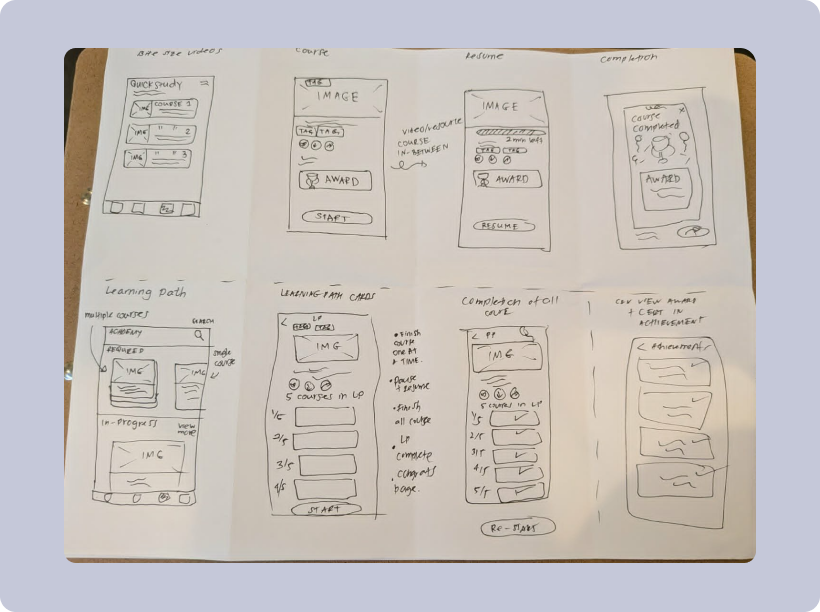
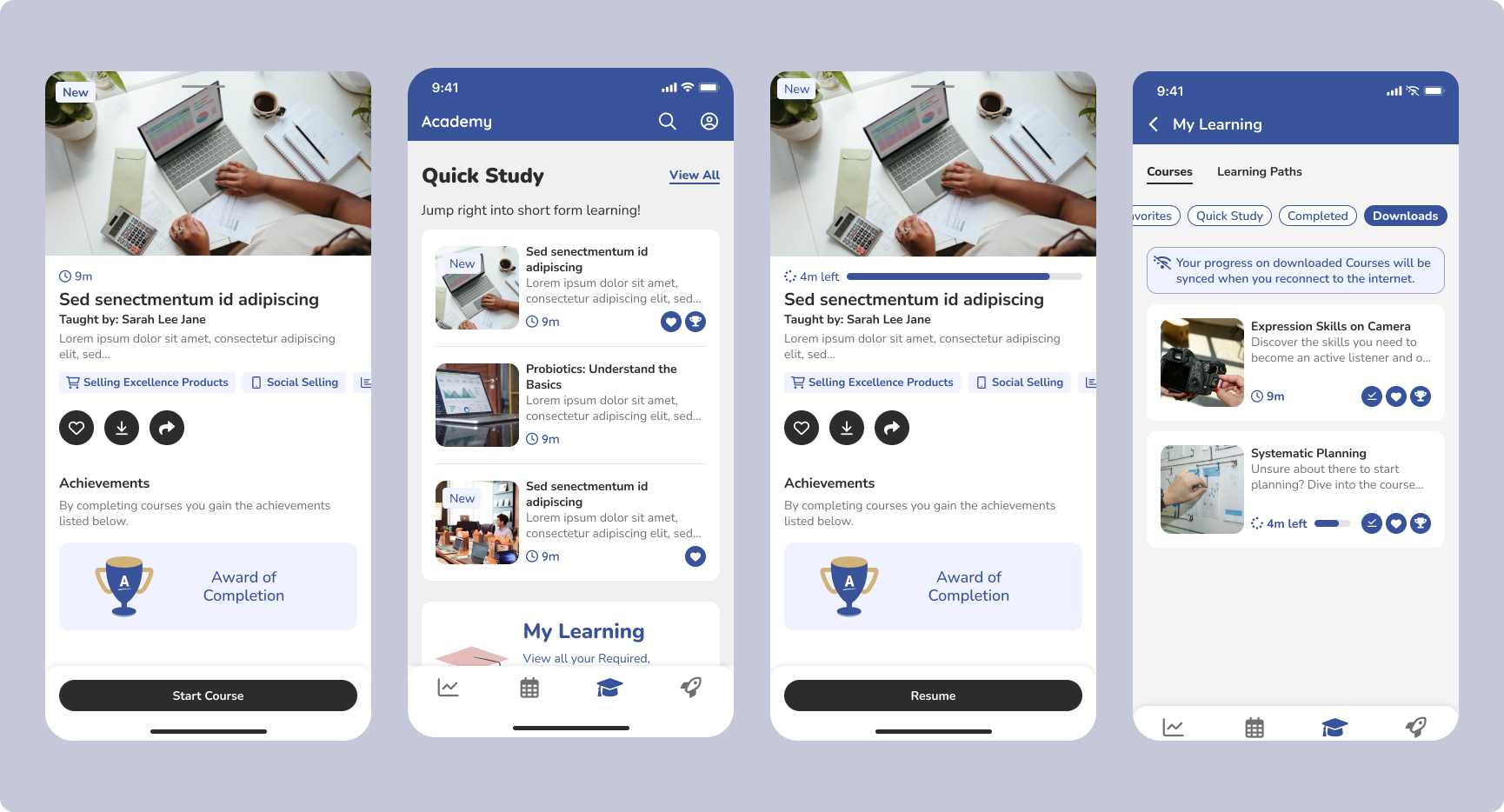
Challenges:Existing materials were long, complex, and not designed for on‑the‑go learning.
Design Exploration:We experimented with bite‑size lesson formats, microlearning patterns, and mobile‑optimized layouts to improve comprehension and completion rates.
Inconsistent Training Across Uplines and Markets
Challenges: ABOs received varying information depending on who trained them, leading to confusion and compliance risks.
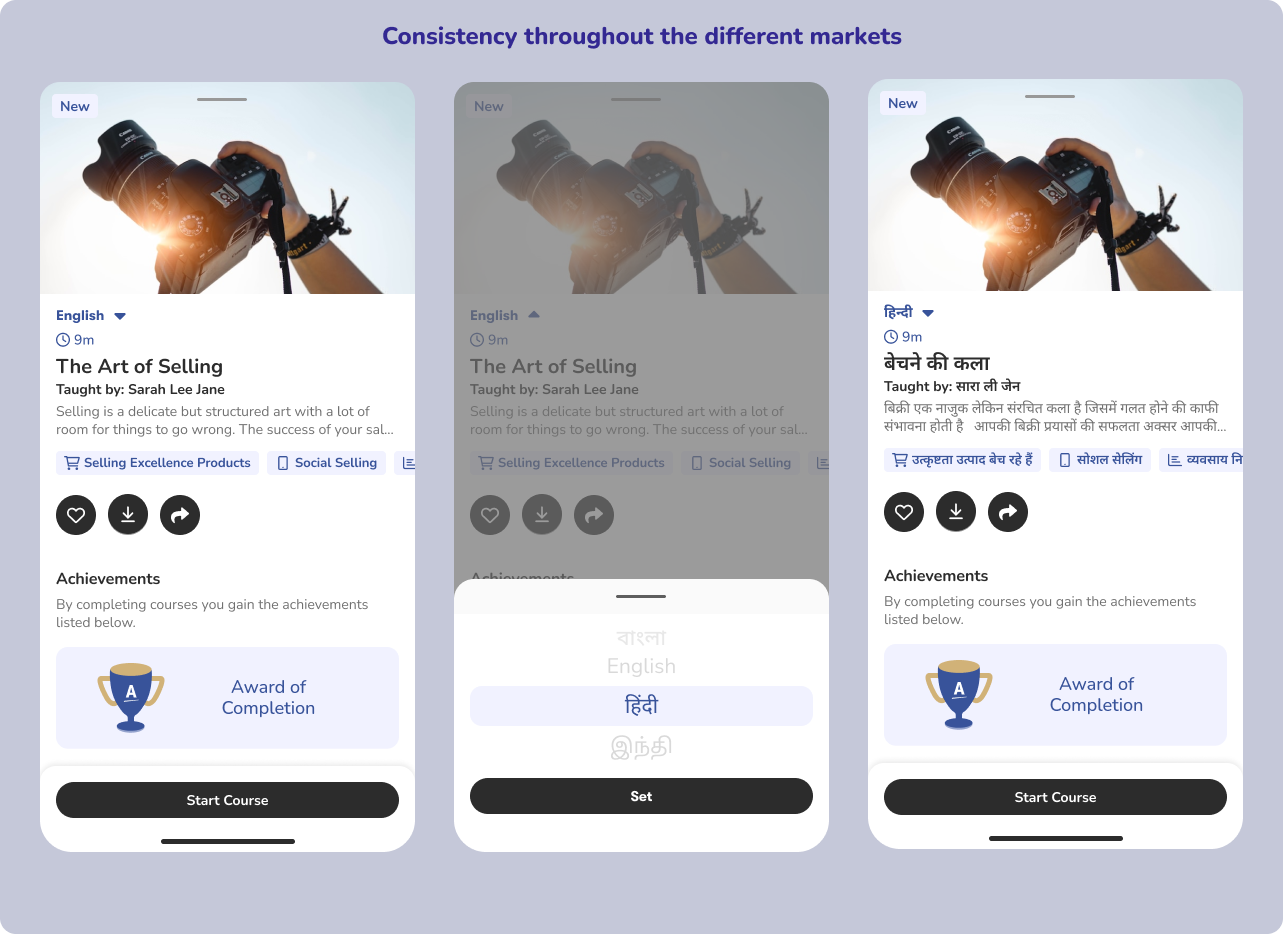
Design Exploration:We explored modular content systems, standardized templates, and scalable lesson structures that markets could localize without breaking consistency.
Gamification Exploration
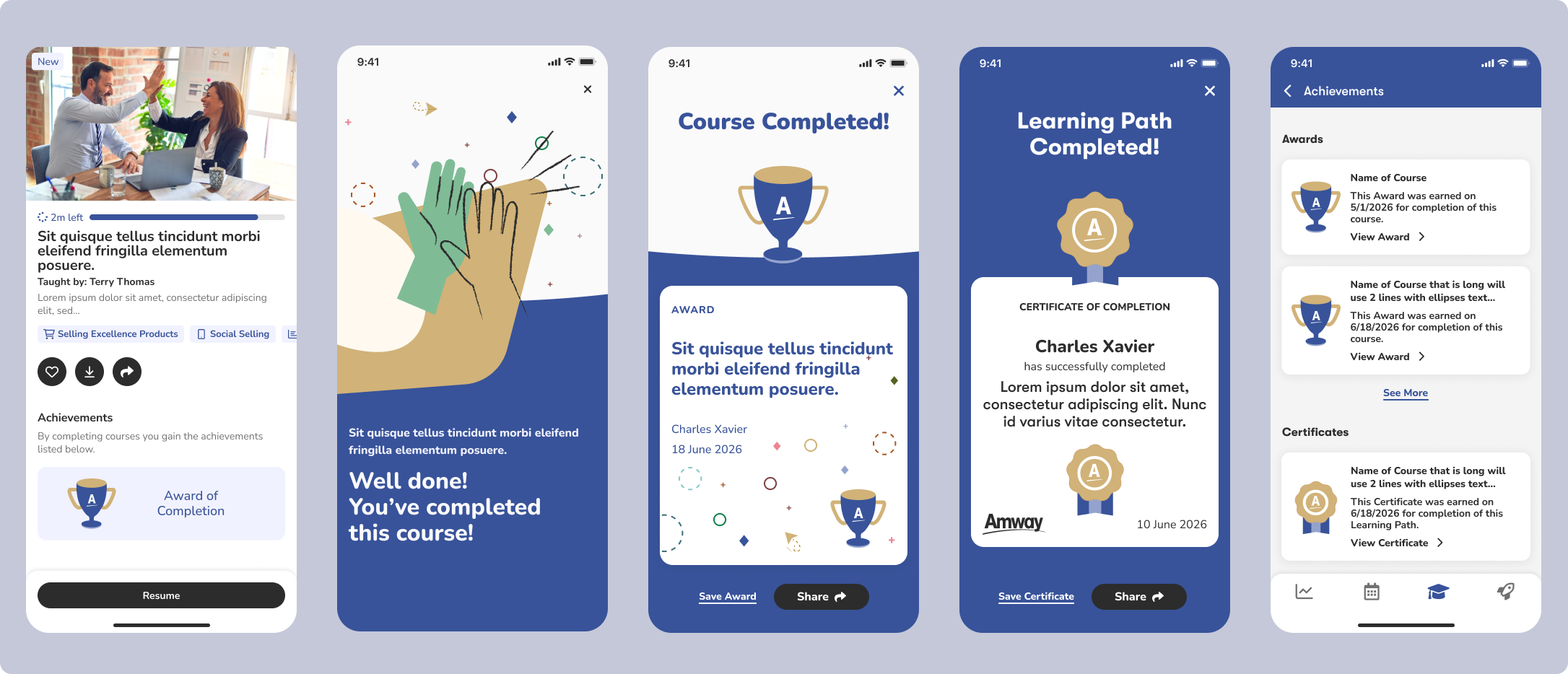
Challenges: ABOs often dropped off after onboarding. They needed motivation to continue learning and complete lessons consistently.
Design Exploration: Light-touch gamification such as progress indicators, completion screens, earning awards, certificates, and showing off badges. The goal was to create positive reinforcement and help ABOs track progress in a simple, motivating way, as well as enable them to share their progress and awards with other business owners.
Mobile + Admin Side-by-Side (System Thinking)
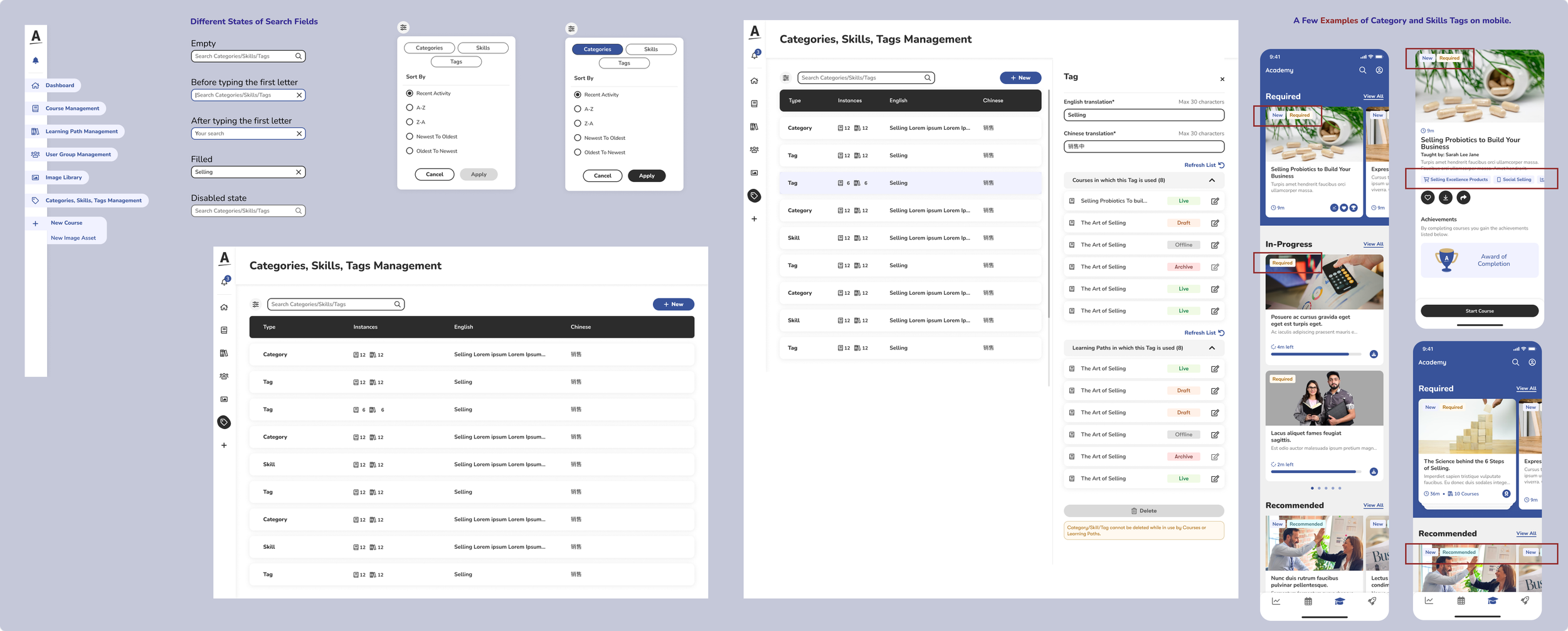
Challenges: Academy needed to support both learners and admins with consistent, scalable experiences. The system had to work seamlessly across both sides. Admins needed a way to organize content so ABOs could easily find the right courses. Without a shared tagging and categorization system, content would become scattered, inconsistent, and hard to discover.
Design Exploration: A unified tagging system connects the admin tools with the mobile learning experience. Admins add tags and categories to each course—such as Selling Skills, Product Knowledge, Compliance, or New Market Launch. On the ABO side, learners search for the tags they’re interested in or receive required tags assigned by admins. New tags added in the admin dashboard instantly appear on mobile, creating a structured, consistent, and easy-to-navigate learning experience across markets.
Outcome & Impact
★ 4.5 stars
Rolled out across 100+ international markets, securing 350k downloads.
Designed to support a global network of 1 million active business owners (IBOs/ABOs) worldwide.
Localized support for 40–60+ languages to unify training across diverse regional teams.
Became the primary learning platform for product knowledge, onboarding, and compliance
Launched in 100+ markets, the redesigned ABO/IBO Academy drove a 400% increase in active users and a 112% jump in course completions—making training easier, faster, and more consistent worldwide.

Reflection
Working on ABO/IBO Academy was a defining moment in my growth as a designer. Building a global learning platform from the ground up pushed me to take ownership in ways I hadn’t experienced before. When the design lead was unavailable, I often stepped in as the sole designer, leading major discussions, driving clarity in cross‑functional meetings, and making decisions that shaped the product across more than 100 markets.
Collaborating closely with the PM and development team strengthened my ability to communicate design intent, advocate for users, and guide a complex product forward. Although I would have appreciated more consistent design support, the experience ultimately expanded my confidence, autonomy, and leadership.
The rollout also surfaced opportunities for continued improvement, especially around content quality and admin workflows, which informed the next phase of enhancements. Overall, this project taught me how to design at global scale, navigate distributed teams, and step into ownership when the moment calls for it. It remains one of the most impactful projects of my career.